OpenClaw gateway failed to start: Invalid config after upgrade
You upgraded an OpenClaw instance to 2026.5.30 or newer (for example
2026.6.1), and now the gateway crash-loops at startup with the exact line
Gateway failed to start: Invalid config. The config that worked yesterday suddenly fails
validation. The fix is not a restart — it is a config rewrite. OpenClaw 2026.5.30 unified its OpenAI
provider handling, and three concrete schema renames invalidate older configs: rename the provider
openai-codex → openai (id and auth entry), rename the api
openai-codex-responses → openai-chatgpt-responses, and move
agentRuntime from per-agent scope to provider scope. Then validate against the real schema
before you restart.
- The error is generic — "Invalid config" — and points at no specific key, so it reads like a deep bug rather than three renames.
- The config was working an hour ago, so the instinct is to roll back the deploy or restart the pod, neither of which is the cause.
- Restarting feels like it should help and never does, because the broken file is sitting on the disk the pod re-reads on every boot.
- Most search results say "run
openclaw doctor --fix" and stop, without naming what the upgrade actually changed.
What "Gateway failed to start: Invalid config" actually means here
On 2026.5.30, OpenClaw consolidated how it handles OpenAI. Before that version, a Codex-on-OpenAI setup
used a distinct openai-codex provider with its own auth entry, an api id of
openai-codex-responses, and an agentRuntime setting attached per agent. The
2026.5.30 schema collapses all of that into a single openai provider and moves the runtime
selector up to provider scope.
Your existing config still references the old names. The new validator does not recognize them, so it rejects the whole file before the gateway ever finishes booting. That is the entire mechanism. It is not your provider key, your network, or your auth — it is a schema mismatch introduced by the version bump.
Why restarting the gateway never fixes it
This is the part that wastes the most time. The invalid config persists on disk (on a managed PVC, or wherever your gateway config lives self-hosted). When the pod restarts, it re-reads the same file, fails the same validation, and goes straight back into CrashLoopBackOff. There is no transient state to clear, no cache to flush. A restart is a no-op against a config the validator already rejected.
The corollary: you must edit the config to the new schema first. The restart is the last step, not the first one. If you are reflexively restarting crash-looping pods, read recovering an OpenClaw CrashLoopBackOff without restart spam first — restart spam hides the real signal in the logs.
The three breaking renames from the unified-OpenAI migration
| What it is | Old (pre-2026.5.30) | New (2026.5.30+) |
|---|---|---|
| Provider id + auth entry | openai-codex | openai |
| API id | openai-codex-responses | openai-chatgpt-responses |
agentRuntime scope | per-agent | provider |
All three have to be applied. Fixing one rename and missing another leaves the config invalid, and you get the same startup failure with no extra hint about which key is still wrong.
How to tell this apart from other startup failures
| Symptom | Most likely cause |
|---|---|
Invalid config appears right after a bump to 2026.5.30+, config was fine before | Unified-OpenAI schema renames (this guide) |
| Validation error mentions the network bind / interface, not OpenAI | A different post-upgrade config tightening — check your bind setting, not the provider |
| Gateway starts, then a coding turn fails with a model-not-supported harness error | Model reference mismatch downstream of the same migration, but config is valid |
| Crash loop with no "Invalid config" line at all | Not this issue — read the actual startup log line, don't assume |
Stop babysitting your OpenClaw box
Fix it once — or stop fixing it for good.
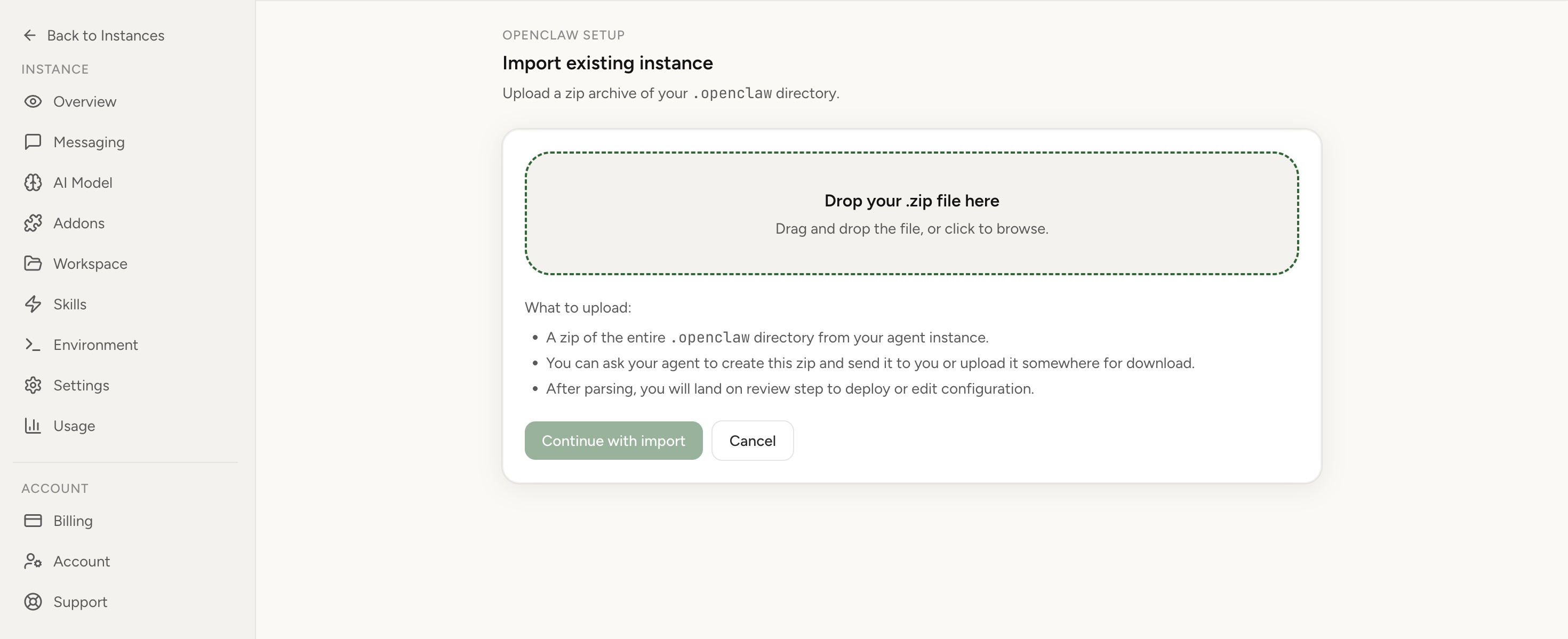
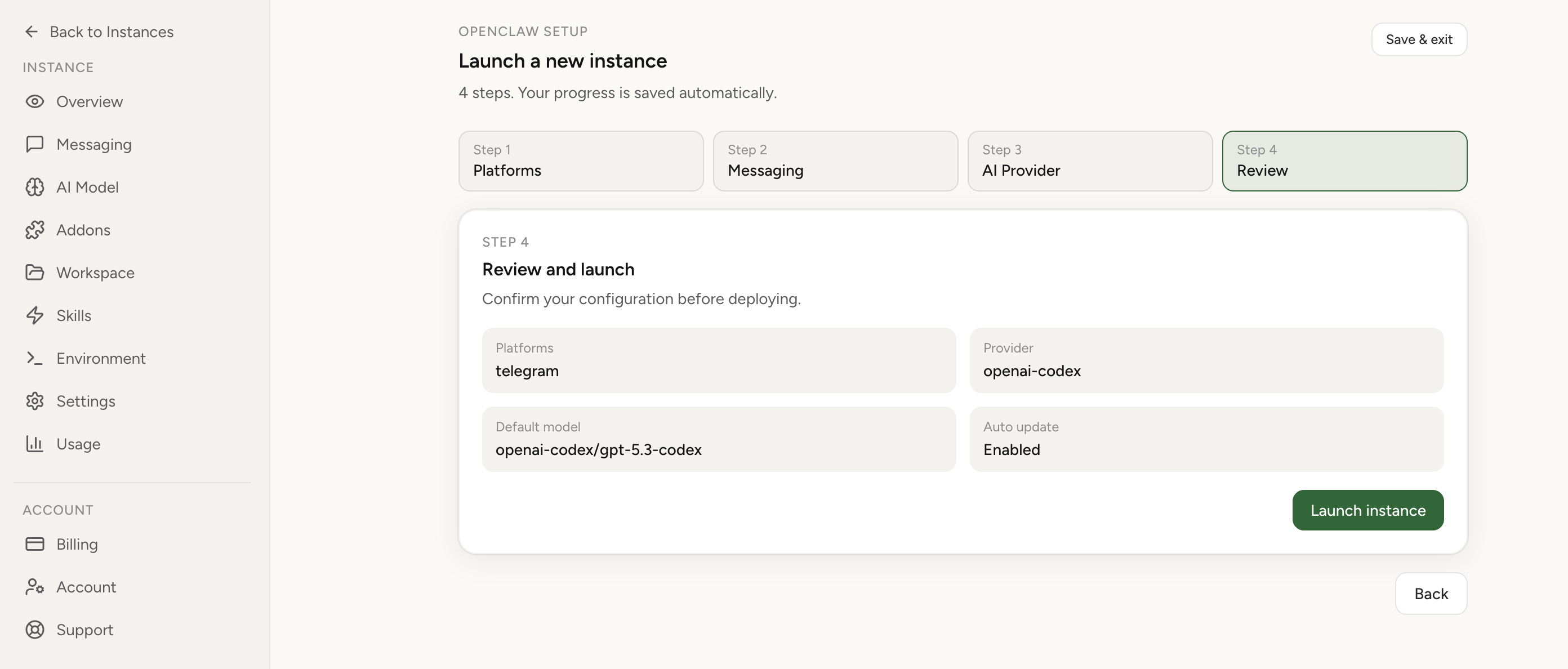
Apply the checklist above and keep self-hosting, or skip the maintenance entirely: run your OpenClaw on managed hosting from $6.90/mo, starting with a 7-day free trial. We handle the stale locks, gateway restarts, version upgrades, and uptime — and you can import your existing instance in a couple of minutes. Cancel anytime.
- Managed hosting handles stale
.jsonl.lockfiles, gateway restarts, and version upgrades for you - Import your existing OpenClaw setup in minutes — keep your channels and configuration
- The optional $199 setup is scoped: no custom development, enterprise/SRE support, or unsupported self-hosting repair
If you would rather compare options first, review OpenClaw cloud hosting or see the best OpenClaw hosting options before deciding.
Step-by-step fix
1) Back up the current config before you touch anything
Copy the gateway config somewhere safe. You want a clean rollback target, and if you decide to run
openclaw doctor --fix later you will want the original to diff against.
2) Apply the three renames in the config
Open the gateway config and make every change from the table above:
- Rename the provider id
openai-codextoopenai, and rename its auth entry toopenaias well. - Rename the api id
openai-codex-responsestoopenai-chatgpt-responses. - Move
agentRuntimeoff each agent and onto theopenaiprovider (provider scope).
Search the whole file for the old strings — these names often appear in more than one place (provider definition, auth block, and per-agent runtime), and a stray reference keeps the config invalid.
3) Validate against the exact version's schema — before restarting
This is the step that turns one clean restart into a guaranteed one. Install the same version you upgraded to and let its real validator check your edited config:
npm i -g openclaw@2026.5.30   # or the exact version you upgraded to, e.g. 2026.6.1
openclaw doctor               # confirm the config parses against the real schema
You can also run openclaw gateway run against the config to confirm it boots locally. If
doctor still flags something, you have a rename left to apply — fix it and re-run. Do not
touch the live gateway until this is green.
4) Restart the gateway — now it's the last step
With a config that validates against the real schema, restart the gateway. This time it boots cleanly instead of crash-looping, because the file it re-reads is finally valid.
About openclaw doctor --fix
The generic advice across most search results is to run openclaw doctor --fix and walk away.
It can rewrite the references for you, but in our experience the dependable path is the explicit one above:
back up the config, apply the three renames yourself, and validate against the exact version's schema
before you restart. If you do use --fix, treat its output as a starting draft — diff the
result against your backup and validate it against the real schema before you restart, rather than
blind-trusting it on a config you care about.
Result verification
- The startup log no longer prints
Gateway failed to start: Invalid config. - The pod leaves CrashLoopBackOff and reaches a running, ready state.
openclaw doctoragainst the same version reports no config errors.- A real coding turn through the
openaiprovider completes — proving the renamed provider, api, and runtime all resolve. - No old
openai-codexoropenai-codex-responsesstrings remain anywhere in the config.
Edge cases and judgment calls
You validated against the wrong version
Validating with a globally installed OpenClaw that is not the version you upgraded the instance
to defeats the purpose. The schema is version-specific. Pin npm i -g openclaw@<version>
to the exact target before running doctor.
You only renamed the provider, not the api or the runtime scope
Then the config is still invalid and you will see the same failure. The three renames are a set, not a menu. Re-check the table.
The gateway boots but a turn errors with a model harness message
That is a separate, downstream symptom of the same migration — the config is now valid, but a model reference elsewhere still points at the old shape. Fix the model reference; do not undo your config renames.
Typical mistakes
- Restarting the pod or gateway repeatedly instead of editing the config — the broken file is on disk and re-read every boot.
- Rolling back the whole upgrade when only three renames were needed.
- Applying one or two of the renames and missing the third.
- Skipping local validation and discovering the next missed key only after another crash-loop.
- Running
doctor --fixblind on a production config without a backup or a post-diff.
How a managed host avoids this on every bump
On Lobsterland, the config generator is version-gated: it switches to the unified-openai schema exactly at 2026.5.30 and emits the correct provider, api, and provider-scoped runtime automatically on upgrade. Managed instances never hit "Invalid config" on this version bump — the new schema is written for you before the gateway boots. If you would rather not hand-edit a config on every breaking release, start with OpenClaw Setup, weigh the tradeoffs on /compare/, and look at managed OpenClaw hosting for upgrades that don't require a schema rewrite.
Import your current OpenClaw instance in 1 clickFAQ
What changed about the OpenAI provider in 2026.5.30?
OpenClaw unified its OpenAI handling. The openai-codex provider (id and auth) collapsed into
openai, the api openai-codex-responses became openai-chatgpt-responses,
and agentRuntime moved from per-agent to provider scope. Any config still using the old names
fails validation.
Will a plain pod restart ever clear this?
No. The invalid config is on disk and is re-read on every boot. You must rewrite it to the new schema; the restart only succeeds after the file validates.
Is openai-codex still valid?
Not on 2026.5.30+. Rename it — and its auth entry — to openai, rename the api to
openai-chatgpt-responses, and move agentRuntime to provider scope.
How do I stop this happening on every upgrade?
Either keep a validate-before-restart discipline (install the target version, run openclaw doctor,
restart only when green), or move to a managed host whose config generator emits the correct schema per
version. On OpenClaw cloud hosting the version-gated generator
handles the 2026.5.30 schema for you so the bump is uneventful.