claude setup-token: what it authenticates, and why it fails
claude setup-token mints a one-year OAuth token for Claude Code, prints it to your terminal, and saves it nowhere. You paste it intoCLAUDE_CODE_OAUTH_TOKEN — or into an agent host that asks for a Claude Code token — and the agent authenticates to Claude as your Claude Code login. That is the whole mechanism. The two failures that account for most of the trouble afterwards are thatanother credential in the same environment outranks it, or thatthe token was issued with a narrower scope than the thing you pointed it at. Neither produces a helpful error, and two further causes below are specific to OpenClaw.
- One-year OAuth token. Requires a Pro, Max, Team or Enterprise plan. Model requests only.
- It is fifth in Claude Code's credential precedence. An
ANTHROPIC_API_KEYin the same environment wins and yours is ignored. - Since early 2026 it can be issued restricted to Claude Code:“Your OAuth token is restricted to Claude Code and can't be used for external API calls.”
- A token credential carries no refresh material. At twelve months it stops; it does not renew.
- It does not reliably bill to your Claude plan on a hosted agent. Budget it as API spend.
- If you want predictable Anthropic costs on an always-on agent, use anAnthropic API key. That is also what OpenClaw's own docs recommend.
What claude setup-token actually mints
Anthropic'sClaude Code authentication documentationdescribes the command in one paragraph, and the details it chooses to state are the ones people trip over. The command exists “for CI pipelines, scripts, or other environments where interactive browser login isn't available”. It opens the same browser authorization flow as /login. The token prints to the terminal, and — in the documentation's words — “it does not save the token anywhere”.
| Property | Value |
|---|---|
| Lifetime | One year |
| Plan required | Claude Pro, Max, Team or Enterprise |
| Where it goes | CLAUDE_CODE_OAUTH_TOKEN |
| Stored by the command | Nowhere — it prints once |
| Capability | Model requests only |
| Cannot do | Remote Control sessions, claude.ai connectors, bare mode |
| Refresh | None — the credential has no refresh material |
Two consequences follow immediately. Because the command stores nothing, a token you fail to copy is gone and you mint another. And because it “can only make model requests”, it is a narrower credential than an API key by design — a distinction that becomes the whole story below.
Where the token ranks against your other credentials
This is the single most useful fact about claude setup-token and it is published in Anthropic's documentation rather than in any guide about it. When several credentials are present, Claude Code picks one in a fixed order:
| # | Credential source |
|---|---|
| 1 | Cloud provider credentials (Bedrock, Vertex, Foundry) |
| 2 | ANTHROPIC_AUTH_TOKEN |
| 3 | ANTHROPIC_API_KEY |
| 4 | apiKeyHelper script output |
| 5 | CLAUDE_CODE_OAUTH_TOKEN — your setup-token |
| 6 | Anthropic profile / federation credentials |
| 7 | Subscription OAuth credentials from /login |
Your setup-token is fifth of seven. Anthropic states the interactive case plainly: “If you have an active Claude subscription but also haveANTHROPIC_API_KEY set in your environment, the API key takes precedence once approved.” On a server, in a Dockerfile, or in a CI job, the same rule applies without anybody being there to notice — a key exported months ago in a shell profile quietly shadows the token you just minted, and the symptom is “my setup-token isn't working” when the real symptom is “my setup-token was never consulted”.
Check this before you debug anything else. On the machine that actually runs the agent, confirm that ANTHROPIC_API_KEY, ANTHROPIC_AUTH_TOKEN and anyapiKeyHelper setting are unset. Unsetting them in your interactive shell proves nothing about the environment a service manager hands to the process.
Why claude setup-token returns 401 or gets ignored
Four causes, in the order worth checking them. Only the first is free to rule out.
1. Another credential outranks it
Covered above. No error, no log line, no 401 — the agent simply bills somewhere you did not intend. This one is silent, which is why it belongs first.
2. The token was issued with Claude Code-only scope
In February 2026 the scope the command requests narrowed. The resulting token can be rejected for anything outside Claude Code itself, with a specific and quotable string:
Error: Your OAuth token is restricted to Claude Code and can't be used for external API calls.That isclaude-code issue #23703, opened 2026-02-06 against Claude Code 2.1.34 and closed as a duplicate. The reporter names the case exactly: “Claude setup-token is now only requesting user interface scope? this is making it impossible to use it for openclaw” — and confirms it as a regression, “this worked in a previous version”. If you see that string, no amount of re-pasting helps; the credential you hold is not the credential you need.
3. Mode and type disagree in OpenClaw's config
OpenClaw records a credential in two places — the profile's declared mode in the gateway config, and the profile's type in the agent's auth profile store. When those disagree, authentication fails with the generic 401 rather than a configuration error.OpenClaw issue #2697 (2026-01-27, v2026.1.24-3) is the worked example: a successful claude login, a profile written as mode: token against an auth profile oftype: oauth, a lastGood pointer aimed at a different profile name, and “401 Invalid bearer token” on every request. The fix was to make the two agree and restart the gateway.
4. One bad credential takes the whole provider down
This is the failure that turns a credential problem into an outage.OpenClaw issue #9095 (2026-02-04, v2026.2.2-3) records HTTP 401 authentication_error: Invalid bearer token followed by No available auth profile for anthropic (all in cooldown or unavailable). Once the provider is in cooldown, every Claude variant disappears at once and the fallback chain has nothing to fall back to. If your agent went from “Claude is misbehaving” to “no models at all”, this is the shape — and the recovery is to fix the credential and restart the gateway, not to wait it out.
A related and much older report is worth knowing about if the token is being ignored entirely rather than rejected:claude-code issue #8938 (opened 2025-10-04, still open, labelled area:auth andhas repro) records Claude Code 2.0.5 still prompting for theme and authentication method with CLAUDE_CODE_OAUTH_TOKEN exported and local config removed. On an unattended box that prompt is indistinguishable from a hang.
What a setup-token does not buy you
Four limits, three of them documented by Anthropic and one structural.
- It is not a general Anthropic credential. The documentation states it “can only make model requests, so it can't establish Remote Control sessions or fetch claude.ai connectors”. Locally configured MCP servers still work.
- Bare mode does not read it. If a script passes
--bare, Anthropic directs you toANTHROPIC_API_KEYor anapiKeyHelperinstead. - It does not renew. A token credential is stored as a provider and a token value and nothing else — no access/refresh pair, no expiry timestamp. There is no refresh material for a runtime to use, so automatic token refresh does not apply to it. At twelve months it simply stops working and a human re-mints it.
- It does not reliably move your agent's usage onto your Claude plan.The token authenticates and the agent runs, but Anthropic limits Claude subscription use from third-party and hosted clients, so that traffic can draw additional metered usage instead of being absorbed by Pro or Max. This is the one that costs money rather than uptime, because nothing fails when it happens. If you are working out what changed and what your options are, we wrote that up separately inOpenClaw after the Claude subscription cutoff.
We are not the only ones saying this, and it is worth reading in the runtime's own voice rather than a host's: OpenClaw'sOAuth documentationconcludes that “for Anthropic in production, API key auth is still the safer recommended path”. If you want a subscription route that behaves the way people expect this one to, it is ChatGPT (Codex) rather than Claude — seeconnecting OpenAI to OpenClaw.
Using a setup-token on a hosted OpenClaw agent
There is a reason hosted users meet this credential's edges before anybody else does. OpenClaw prefers Claude CLI reuse — picking up an existing interactiveclaude login on the same machine. A headless always-on agent has no interactive login to reuse. The paste-a-token path exists precisely to cover that case, which means every hosted Claude-subscription user is on the narrower credential by construction.
On Lobsterland this is a first-class auth method rather than a workaround. You pickClaude Code Token as the Anthropic auth method in the instance wizard or on the AI Model screen, paste the value the command printed, and the platform writes the credential into the right shape for the runtime you chose: an OpenClaw auth profile of type token, or, for a Hermes instance, theCLAUDE_CODE_OAUTH_TOKEN environment variable with the provider pinned so the runtime selects it. The token our fleet stores for this method is thesk-ant-oat… value the command prints — if what you pasted does not look like that, you copied the wrong line out of the terminal.
One class of failure above is genuinely off the table here. The mode-versus-type disagreement behind issue #2697 comes from two tools writing the same credential differently; our control plane derives both from one code path that refuses to emit a Claude Code credential in any mode other than token, so the pair cannot drift apart. The other three are upstream and stay upstream.
Stop babysitting your OpenClaw box
Fix it once — or stop fixing it for good.
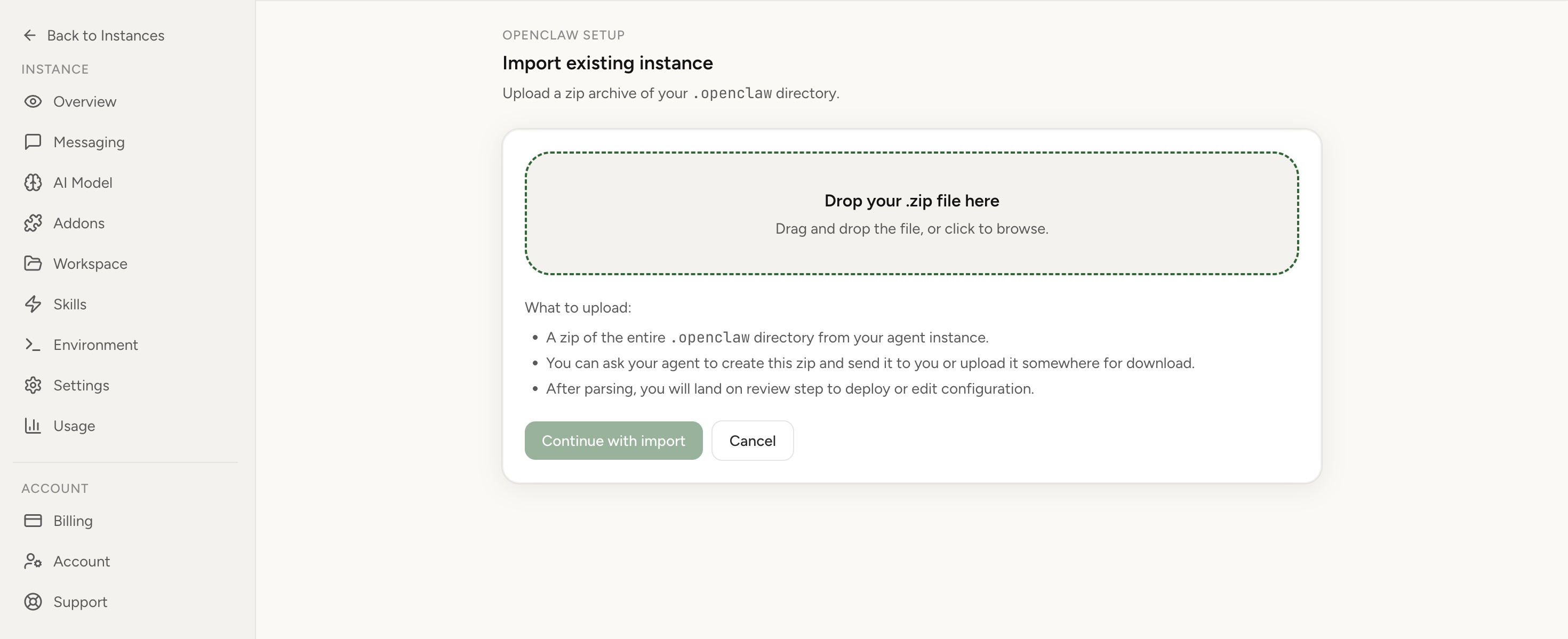
Apply the checklist above and keep self-hosting, or skip the maintenance entirely: run your OpenClaw on managed hosting from $6.90/mo, starting with a 7-day free trial. We handle the stale locks, gateway restarts, version upgrades, and uptime — and you can import your existing instance in a couple of minutes. Cancel anytime.
- Managed hosting handles stale
.jsonl.lockfiles, gateway restarts, and version upgrades for you - Import your existing OpenClaw setup in minutes — keep your channels and configuration
- The optional $199 setup is scoped: no custom development, enterprise/SRE support, or unsupported self-hosting repair
If you would rather compare options first, review OpenClaw cloud hosting or see the best OpenClaw hosting options before deciding.
Being precise, because most of this is Anthropic's and stays Anthropic's.Managed hosting does not change the scope of your token, its one-year lifetime, or how Anthropic bills a hosted client. If your token comes back restricted to Claude Code, it is restricted on our fleet exactly as it is on your laptop. We cannot make a subscription cover usage that Anthropic has decided it does not cover, and you should not pick a host that implies otherwise.
What changes is the plumbing around it. Onmanaged OpenClaw hosting from Lobsterland the credential is written in one shape by one code path, so the mismatch class of 401 disappears; the environment your agent runs in is ours, so no forgottenANTHROPIC_API_KEY shadows the credential you chose; and switching Anthropic from a setup-token to an API key is a field on the AI Model screen rather than a config edit and a gateway restart. If you are minting the credential for the first time, the step-by-step is inour guide to connecting Anthropic to OpenClaw, and our pricing page is the honest place to compare that against what metered Claude usage will actually cost you. For the adjacent 401 that looks identical but is not, seerefresh token has already been used.
Frequently asked questions
What does claude setup-token do?
It mints a long-lived OAuth token for Claude Code. Anthropic's authentication documentation states the token is valid for one year, that the command opens the same browser authorization flow as /login, that the token prints to the terminal and "does not save the token anywhere", and that it "authenticates with your Claude subscription and requires a Pro, Max, Team, or Enterprise plan". You copy the printed value and set it as the CLAUDE_CODE_OAUTH_TOKEN environment variable, or paste it into whatever tool is asking for a Claude Code token. It is a credential-minting command, not a configuration command: nothing on your machine changes when you run it.
Why does my Claude setup-token return 401 Invalid bearer token?
There are four common causes and they need different fixes. First, precedence: Anthropic documents CLAUDE_CODE_OAUTH_TOKEN as the fifth credential source, below ANTHROPIC_AUTH_TOKEN, ANTHROPIC_API_KEY and apiKeyHelper, so a stale API key in the same environment silently wins and your token is never used. Second, scope: since early 2026 the minted token can come back restricted, with the error "Your OAuth token is restricted to Claude Code and can't be used for external API calls" (claude-code issue #23703, opened 2026-02-06 on version 2.1.34). Third, a mode and type mismatch between OpenClaw's config and its auth profile, which produced exactly this 401 in openclaw issue #2697 (2026-01-27, v2026.1.24-3). Fourth, the token expired: a one-year token has no refresh material, so it fails outright rather than renewing.
Does a Claude setup-token let a hosted agent run on my Claude Pro or Max plan?
Do not plan on it. The token authenticates and the agent runs, but Anthropic limits Claude subscription use from third-party and hosted clients, so that traffic can draw additional metered usage instead of being absorbed by your Claude Pro or Max plan. Nothing fails loudly when this happens, which is why it is usually discovered on a bill rather than in a log. For predictable Anthropic costs, use an Anthropic API key. OpenClaw's own documentation reaches the same conclusion: "for Anthropic in production, API key auth is still the safer recommended path". If you specifically want a subscription that behaves as advertised on an agent, the ChatGPT (Codex) route is the one that currently does.
How long does a Claude setup-token last, and does it refresh itself?
One year, and no. Anthropic documents the command as generating a one-year OAuth token. The distinction that matters for an always-on agent is structural: on Lobsterland a setup-token is stored as a token-type auth profile that carries only the provider and the token value, while a full OAuth profile carries an access token, a refresh token and an expiry. A token profile has no refresh material, so there is nothing for the runtime to renew. When it expires, a human runs claude setup-token again and re-pastes the result. Plan the calendar reminder when you create it, not when the agent goes quiet.
What can a Claude setup-token not be used for?
Anthropic's documentation is explicit that the token "can only make model requests, so it can't establish Remote Control sessions or fetch claude.ai connectors", though locally configured MCP servers still work. It is also not read in Claude Code's bare mode, where an ANTHROPIC_API_KEY or an apiKeyHelper is required instead. And since the 2026 scope narrowing it may be issued restricted to Claude Code itself, in which case external API calls are refused outright. Treat it as a subscription-scoped credential for model calls, not as a general-purpose Anthropic key.